
What Living in an ADHD Household Has Taught Me

There were always socks under the computer table.
I don't mean occasionally. I mean every single day.
When Ben and I were dating, I would pick them up, put them in the laundry basket, and somehow the next day there would be another pair sitting in exactly the same spot. Eventually I got so annoyed that I drew a sign and stuck it near the desk.
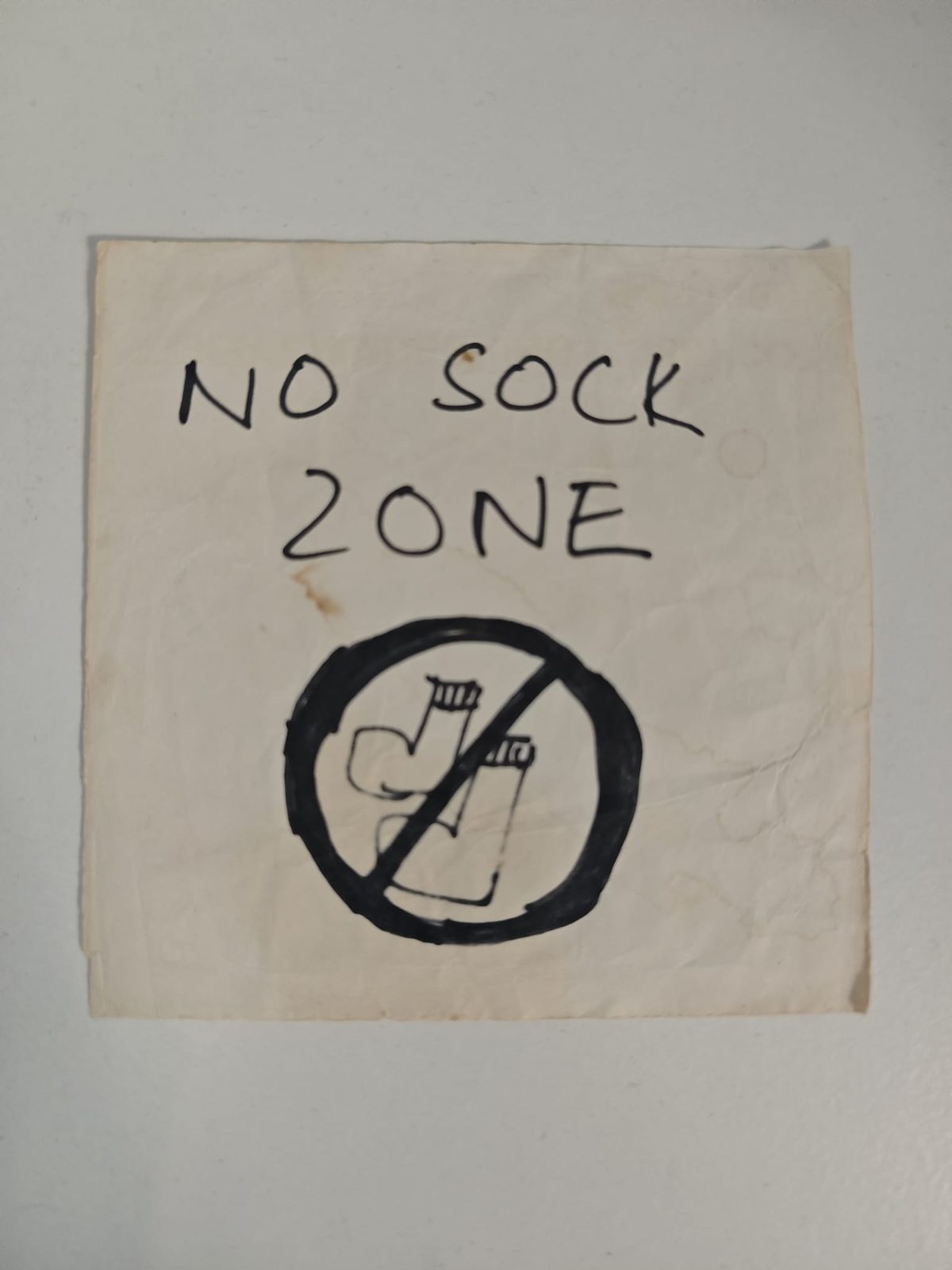
Ben thought it was hilarious.
The annoying thing was that it actually worked. Not because he suddenly became tidier, but because the sign made him aware of something he genuinely wasn't noticing before. Once it was right in front of him, he could do something about it.
At the time I didn't think much of it. It was just one of Ben's quirky habits. Looking back now, it feels like one of the earliest clues that people in this household were processing the world very differently from me.
Fast forward a few years and suddenly our lives were filled with words I had never expected to become part of our everyday vocabulary. Speech therapy. Occupational therapy. Executive functioning. Psycho-educational assessments.
Our journey started when Carson was in Reception. His teachers noticed things we hadn't quite pieced together ourselves yet, and looking back, that early intervention was such a gift. Nobody was trying to label him or fix him. They simply wanted to understand him better and make sure he had the support he needed.
At the time, all of this was completely new to us. I remember sitting in meetings hearing terms I had never heard before and wondering how on earth parents were supposed to navigate all this information. I remember learning about occupational therapy and thinking, where was this when we were growing up?
When Carson was seven, we were encouraged to complete a full psycho-educational assessment, and it explained a lot. As we learned more about Carson, Ben started recognizing pieces of himself too. What began as a journey to better understand one child gradually became a journey to better understand our whole family.
The biggest surprise wasn't the diagnosis. The biggest surprise was realizing how much of my parenting strategy depended on repeating myself.
I genuinely thought repetition was the answer.
"Put your shoes on."
"Carson, shoes."
"Did you hear me?"
"We're late."
"Carson."
Meanwhile Carson would still be completely absorbed in whatever Lego masterpiece he was building, and somehow every single time I expected a different result.
If I'm being honest, I hate confrontation. I hate the tension that builds in the house when everybody starts feeling frustrated, and I especially hate the version of myself that eventually shows up when I've repeated the same thing six times and nobody has moved.
But it was just not working. Time and time again.
One day I realized that the more words I used, the less effective I became. I'd say, "Carson, please put your shoes on, we're running late and we need to leave," and what I thought was one instruction was actually a whole sequence of tasks.
The more we learned about ADHD, the more we learned about executive functioning. Executive functions are the brain's management system. They're the skills that help us plan, organize, switch attention, prioritise, manage time, remember instructions, and get started on tasks. Many of the things neurotypical people do almost automatically can require a lot more conscious effort for someone with ADHD.
Suddenly, so many of our daily battles started to make more sense.
He had to stop what he was doing, shift his attention away from the Lego creation in front of him, process what I had said, remember where his shoes were, find them, put them on, understand that we were running late, and then mentally prepare to leave the house.
It wasn't that Carson was deliberately ignoring me. Quite often, he was still completely immersed in what he was doing. Meanwhile, I was already mentally standing at the front door with my handbag and car keys wondering why nobody was moving.
So instead of giving him the entire sequence, I started with the first step.
"Shoes."

That's it.
Not a reminder about being late. Not a speech about our schedule. Just one word.
Does it work every time? Of course not. But it works often enough that I don't have to repeat myself six times before breakfast, and often enough that mornings don't immediately start with tension.
Another thing that helped was something embarrassingly simple. I stopped shouting from another room.
Instead, I walked over.
I bent down, got eye contact, and then spoke.
No revolutionary parenting strategy. No clever hack. Just me getting close enough that I wasn't competing with Lego, imagination, Minecraft, YouTube, or whatever else currently had his full attention.
And it worked far better than yelling from across the house.
What I've realized over the years is that most of the changes we've made haven't been huge. There wasn't one book, one therapist, one assessment or one breakthrough moment that suddenly changed everything. It was lots of little adjustments. The No Sock Zone. One-word reminders. Moving closer. Explaining why. Trying things. Keeping what worked and letting go of what didn't.
Because I wasn't looking for perfect behavior. I was looking for a way for all of us to live together without constant tension. And when something reduced the tension, we kept it.
Of course there are still mornings when we're late. There are still missing water bottles, unfinished homework, and somebody frantically looking for a shoe they definitely had five minutes ago. There is still shouting sometimes.
But there is less of it.
The house feels lighter than it used to. And honestly, for now, that's enough for me.

